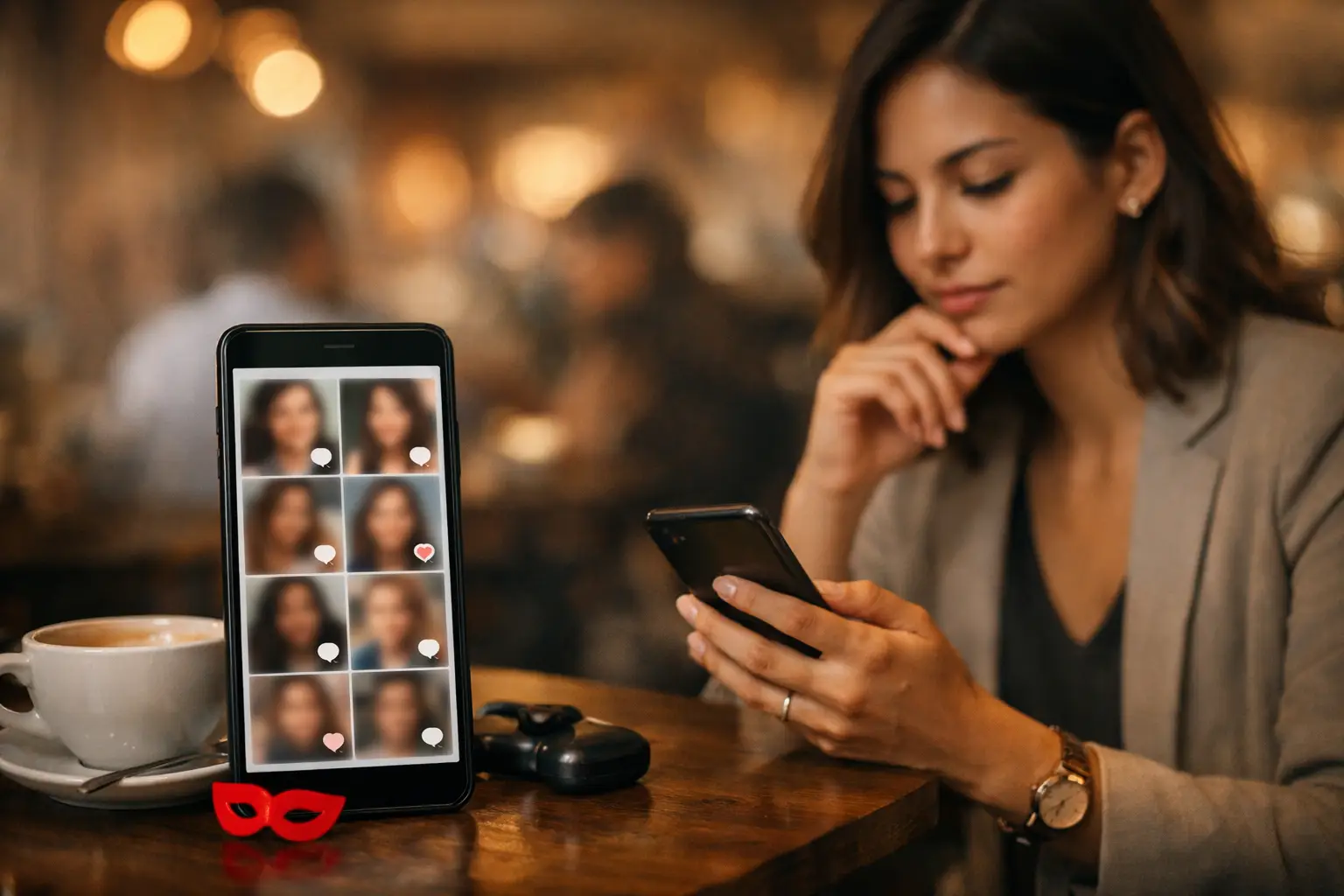
The moment a face photo goes live on a mainstream dating app, control starts to slip. A screenshot can travel, a profile can be recognized by a coworker, and a private interest can become public far faster than most people expect. That is exactly why a dating app with blurred photos appeals to adults who want real connection without giving up discretion on day one.
For people exploring swinging, open relationships, or adult social spaces, that trade-off matters even more. Many are not hiding who they are from each other. They are protecting themselves from employers, relatives, neighbors, and the casual misuse of personal images. Blurred photos are not about playing games. They are about setting a boundary before trust is earned.
What a dating app with blurred photos actually changes
On a typical app, photos do most of the filtering before a conversation starts. That can feel efficient, but it also creates a low-trust environment. People make fast decisions, fake profiles can blend in, and users often reveal more than they mean to through faces, homes, car interiors, workplace clues, or even children accidentally appearing in the background.
A dating app with blurred photos changes the order of operations. Instead of forcing immediate visual exposure, it gives people room to assess basics first - profile quality, verification, intentions, communication style, and whether expectations match. Attraction still matters, but it enters the process with more control.
That does not mean every blurred-photo system works well. If blur is the only privacy feature, users can still be exposed through usernames, visible distance, social handles, or unverified accounts. The stronger model treats blurred images as one part of a wider trust framework.
Privacy is not a niche concern in adult dating
In adult communities, privacy is often the difference between confident participation and staying away entirely. Couples may be professionally visible. Singles may be newly exploring and unsure how public they want to be. Some users live in cities where social overlap is high, and others simply do not want their face circulating on a feed built for browsing.
This is where blurred photos earn their place. They reduce the pressure to choose between two bad options: show everything to strangers or avoid the platform completely. For many adults, especially those in non-monogamous spaces, that middle ground is what makes participation realistic.
There is also a practical side. People tend to share more honestly when they feel safer. Profiles become clearer, messaging becomes more direct, and boundaries are easier to state. Privacy features do not weaken the experience. In many cases, they improve it by attracting users who are serious enough to value discretion.
Why blurred photos can improve trust, not hurt it
At first glance, blurred photos may sound like a barrier. If attraction matters, why obscure the main visual signal? The answer is that privacy and trust are closely linked. When people know they are not being instantly exposed, they are more willing to complete profiles, verify identity, and engage in real conversation.
The better question is not whether photos are blurred. It is how and when they become visible. A strong platform gives users control over who sees what, under which conditions, and after what level of interaction. That creates a more intentional pace.
For adults in the swinger community, this matters because trust usually has more than one layer. There is basic attraction, yes, but there is also legitimacy, relationship status, communication style, comfort level, and whether both people or both partners are actually aligned. Clear privacy controls make room for those checks before faces are fully revealed.
The trade-offs are real
Blurred photos are useful, but they are not a magic fix. They slow visual filtering, and some users will find that frustrating. If someone wants instant swiping based almost entirely on appearance, this style of platform may feel too deliberate.
There is also a difference between mystery and friction. Too much concealment can make a platform feel vague or low-energy. Too little protection defeats the point. The best experience sits between those extremes. You should be able to get a sense of a person or couple without exposing identifying details too early.
That is why profile structure matters. Good platforms let users communicate attraction without overexposure through photo permissions, private galleries, verification badges, and thoughtful profile fields. A blurred public photo works best when it is paired with enough context to show that a real person is behind it.
What to look for beyond blurred photos
If you are considering a privacy-first platform, blurred images should be the starting point, not the whole promise. The quality of the surrounding protections matters more than the blur itself.
Verification is a major signal. In adult dating, fake profiles waste time at best and create real risk at worst. A verified environment raises confidence that the people you are speaking with are genuine and participating in good faith.
Couple functionality also matters. Many mainstream apps treat couples as awkward edge cases, which creates confusion and mismatched expectations. A platform designed for adult social connections should support couple accounts properly, ideally with separate logins and shared control. That helps prevent one-sided communication and makes intentions clearer from the beginning.
Location privacy is another point people often overlook. Even if photos are blurred, precise distance data can expose identity quickly, especially in smaller cities or tight social circles. Obscured location data reduces that risk without making local matching impossible.
Finally, look at how the platform handles personal identifiers and private communication. If discretion is treated as a core design principle, you can usually feel it throughout the product, not just in one feature.
Why this model fits serious adult networks better than mainstream apps
Mainstream dating apps are built for scale. They reward speed, visibility, and broad participation. That works for some use cases, but it is a poor fit for adults who need discretion and more careful screening.
A privacy-focused adult platform serves a different kind of decision-making. Users are not just asking, "Am I attracted?" They are asking, "Is this real, respectful, aligned, and safe to explore?" Blurred photos support that process because they lower the personal risk of showing up in the first place.
That is especially relevant for people entering the lifestyle carefully. New couples often want to learn the space before exposing themselves fully. Singles may want to establish credibility through conversation and verification rather than posting fully visible photos to a public-style grid. A calmer, trust-first environment supports both.
This is one reason platforms like Aphrodite.is stand apart from generic dating apps and chaotic adult sites. When blurred photos are combined with verification, protected identity details, private messaging, and couple-oriented design, discretion becomes part of the experience rather than a patch added later.
Is a dating app with blurred photos right for you?
It depends on what you are trying to protect and how you prefer to connect. If you are comfortable being fully visible to large numbers of strangers, blurred photos may feel unnecessary. But if privacy affects whether you can participate at all, they are often one of the most valuable features available.
They make particular sense if you are part of a couple, work in a public-facing role, live in a smaller community, or simply want to decide who gets access to your face and body on your terms. They are also useful if you are tired of low-trust environments where visibility is high and credibility is low.
The strongest platforms do not ask you to choose between attraction and privacy. They give you a way to manage both. You can signal interest, assess compatibility, verify legitimacy, and reveal more as comfort builds.
That is a better foundation for adult connection than instant exposure disguised as convenience. In spaces where discretion, consent, and mutual respect matter, a little blur at the beginning can lead to much clearer interactions later.