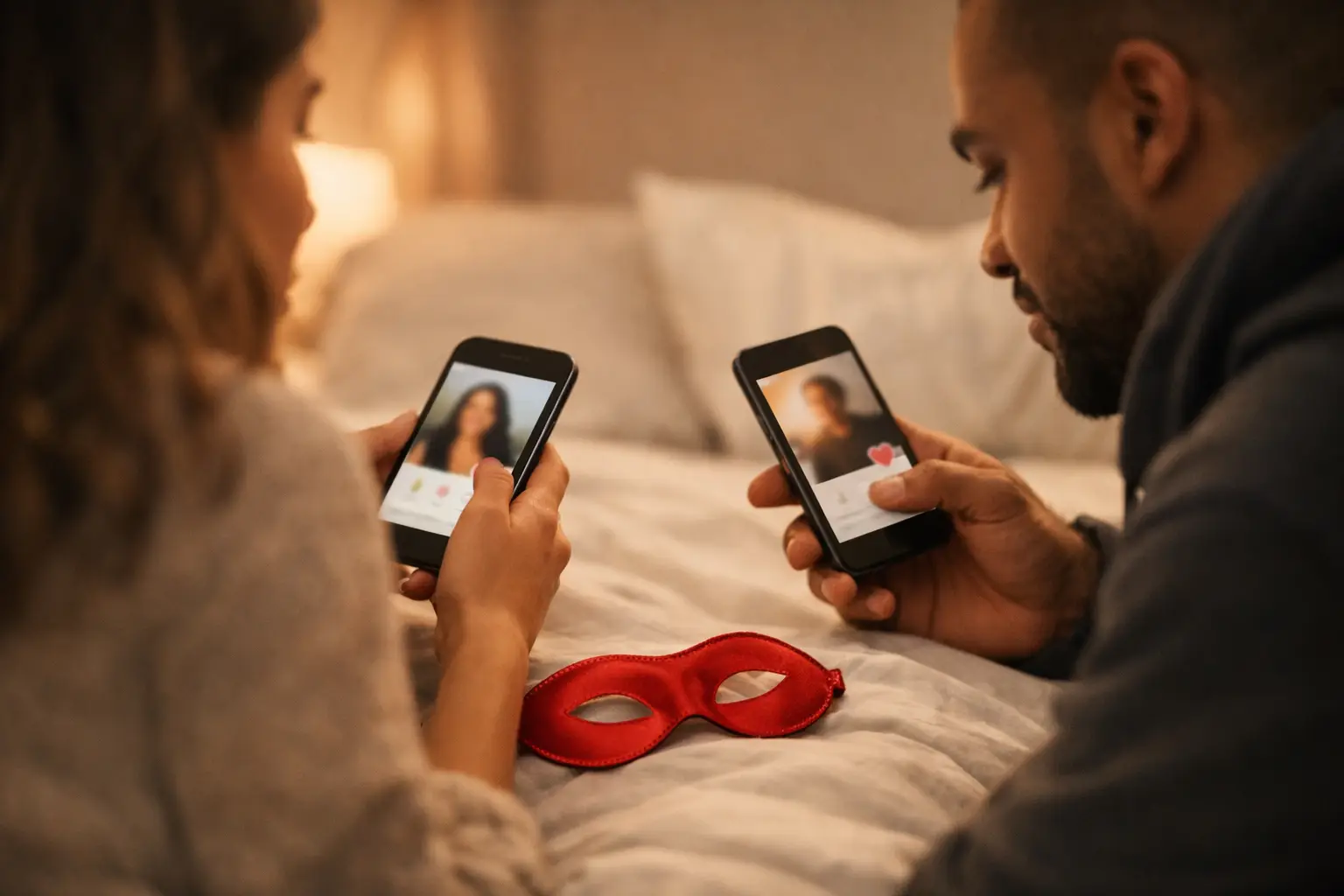
If you are exploring dating apps for swinging, open relationships, or discreet adult connections, privacy is not a nice extra. It is the condition that makes participation feel possible. Knowing how to stay anonymous on dating apps means thinking beyond a hidden face photo. Your identity can leak through your images, your phone number, your location, your writing style, and even the timing of when you are active.
That sounds intense, but it is manageable when you approach it in layers. The safest users are not paranoid. They are simply deliberate. They treat anonymity as a set of habits, not a single setting.
How to stay anonymous on dating apps without disappearing
There is a difference between being anonymous and being vague. On adult dating platforms, especially in lifestyle communities, people still want confidence that they are talking to a real person or a real couple. If your profile reveals nothing, shows nothing, and says nothing specific, it may protect you from exposure, but it can also make you look fake.
The better approach is controlled disclosure. Share enough to signal that you are genuine, respectful, and clear about your interests, while holding back anything that could identify you outside the app. That balance matters even more in communities where discretion and trust carry equal weight.
Start with the basics. Use a separate email address for dating. If the app requires a phone number, consider using a secondary number that is not tied to your personal or work identity. Do not connect your profile to Instagram, Spotify, or any social account that can be traced back to your real name. Convenience usually costs privacy.
Your photos are usually the biggest privacy risk
Most people focus on whether to blur their face. That helps, but it is only part of the picture. A photo can reveal far more than a face. Tattoos, distinctive jewelry, a recognizable bedroom, a workplace badge on a nightstand, or the view from your balcony can all identify you faster than you expect.
Before uploading anything, look at the full frame the way a stranger would. Check the background, mirrors, framed photos, mail on counters, car license plates, and even reflections in windows or appliances. If you are part of a couple account, think about both people’s privacy, not just your own.
Metadata is another issue. Some apps strip location and device data from uploaded images, but you should not assume they all do. A safer habit is to take screenshots of the photos you plan to use or export cleaned copies before uploading. That removes a lot of hidden data.
Face-hidden photos can still work well if they are intentional. Cropped body shots, blurred images, masked photos, and private galleries all give you more control. The trade-off is simple: the less you show publicly, the more important it becomes to write a profile that feels credible and specific.
Location sharing needs a hard boundary
Dating apps often use distance to drive matching. That feature is useful, but it can also narrow your location more than you realize. If someone sees you are two miles away at the same time every evening, they may not need your address to make a good guess.
If the app lets you hide or generalize your distance, use that setting. City-level visibility is usually enough for adult dating. Precise location is rarely necessary early on. In privacy-first spaces, obscured location data is a real advantage because it lets people connect without exposing where they sleep, work, or socialize.
Be careful with your own profile text too. Saying you are "the couple who owns the coffee shop near the harbor" may sound charming, but it defeats every other privacy setting you turned on.
Profile details should be selective, not empty
People often make one of two mistakes. They either overshare and become easily identifiable, or they strip the profile down so much that nobody trusts it. Neither works well.
A strong anonymous profile gives shape without giving away identity. You can say you are a married couple in your late 30s, new to local events, interested in social chemistry first, and more comfortable with private messaging before meeting. That is useful. You do not need to mention your exact neighborhood, employer, children’s ages, or your favorite bar every Friday night.
Writing style matters as well. If you use unusual phrases that people who know you would instantly recognize, that can be identifying in small communities. This does not mean sounding robotic. It means being aware that anonymity includes the way you present yourself.
Verification and anonymity can work together
This is where many users get stuck. They assume privacy and verification are opposites. In practice, good platforms separate the two.
You may want a verified profile because it reduces fake accounts and gives others confidence that you are real. That does not mean your personal identity should be publicly visible. A well-designed adult platform can confirm authenticity behind the scenes while still letting you control what other members see.
That distinction matters a lot in swinger and open relationship spaces, where users often want proof they are not talking to bots, scammers, or stolen photos. Privacy should protect your public-facing identity. Verification should support trust inside the platform. Those goals are compatible when the system is built properly.
Messaging is where anonymity often breaks down
Many users are careful with profiles and careless in chat. That is usually where private details start slipping out.
Do not move to text, WhatsApp, Telegram, or social media too quickly. Keep early conversations inside the app until the other person has earned more trust. Once you switch channels, you may expose your phone number, profile photo, legal name, or activity status across other platforms.
Watch for soft disclosure too. Telling someone where you usually park, what gym you go to, or which hotel you are staying in for a weekend can identify you faster than sending a selfie. If you are chatting as a couple, decide together what details are off-limits before conversations start. Separate boundaries prevent accidental oversharing.
Device and account habits matter more than people think
If privacy is a priority, your phone habits need to match it. Use a strong password. Turn on two-factor authentication if available. Do not leave app previews visible on your lock screen. If you share a tablet or laptop with a partner, children, or roommates, log out when you are done.
Also think about app permissions. A dating app does not always need full access to your contacts, photo library, microphone, or exact location. Grant only what is necessary. The fewer permissions you hand over, the fewer ways your data can move around.
This is one reason privacy-focused platforms stand out. When blurred photos, hidden identifiers, private galleries, and controlled visibility are built into the experience, users do not have to create their own workarounds for basic discretion. On a platform like Aphrodite.is, those protections are treated as product features, not damage control.
How to stay anonymous on dating apps as a couple
Couples have a different privacy equation. You are not just protecting one identity. You are protecting a shared household, a shared social circle, and sometimes very different comfort levels.
The smartest setup is one where both partners can access the account separately, review messages, and agree on what gets shared. That reduces confusion and avoids one partner revealing details the other would have kept private. It also helps maintain consistent boundaries around face photos, meeting plans, and verification.
If one partner is more visible in photos, that person may carry more risk. Talk about that openly. An arrangement that feels fair socially may not feel fair from a privacy standpoint. Couples who handle this well tend to create rules before they start browsing, not after a boundary has already been crossed.
The real trade-off: privacy can slow things down
Anonymity works best when you accept that it may reduce instant attention. Profiles with hidden faces, limited location detail, and careful messaging usually get fewer impulsive replies than profiles that reveal more. That is not always a problem.
For many adults in the lifestyle, slower filtering is better filtering. The people who respond well to boundaries are often the people worth speaking to. Anyone pushing for immediate photos, direct numbers, or exact locations early on is giving you useful information about how they handle consent and discretion.
The goal is not to become invisible. The goal is to stay in control of when, how, and with whom your identity becomes more visible. That is a better standard than hoping strangers will treat your privacy carefully once you have already given it away.
A private dating experience starts long before a first meeting. It starts with the small choices that protect your name, your routine, your images, and your peace of mind. If a platform and its users respect that from the start, discretion stops feeling like a burden and starts feeling like a baseline.